Bhagat Singh Autobiography: Life, Ideals, and the Revolutionary Spirit of a Legend
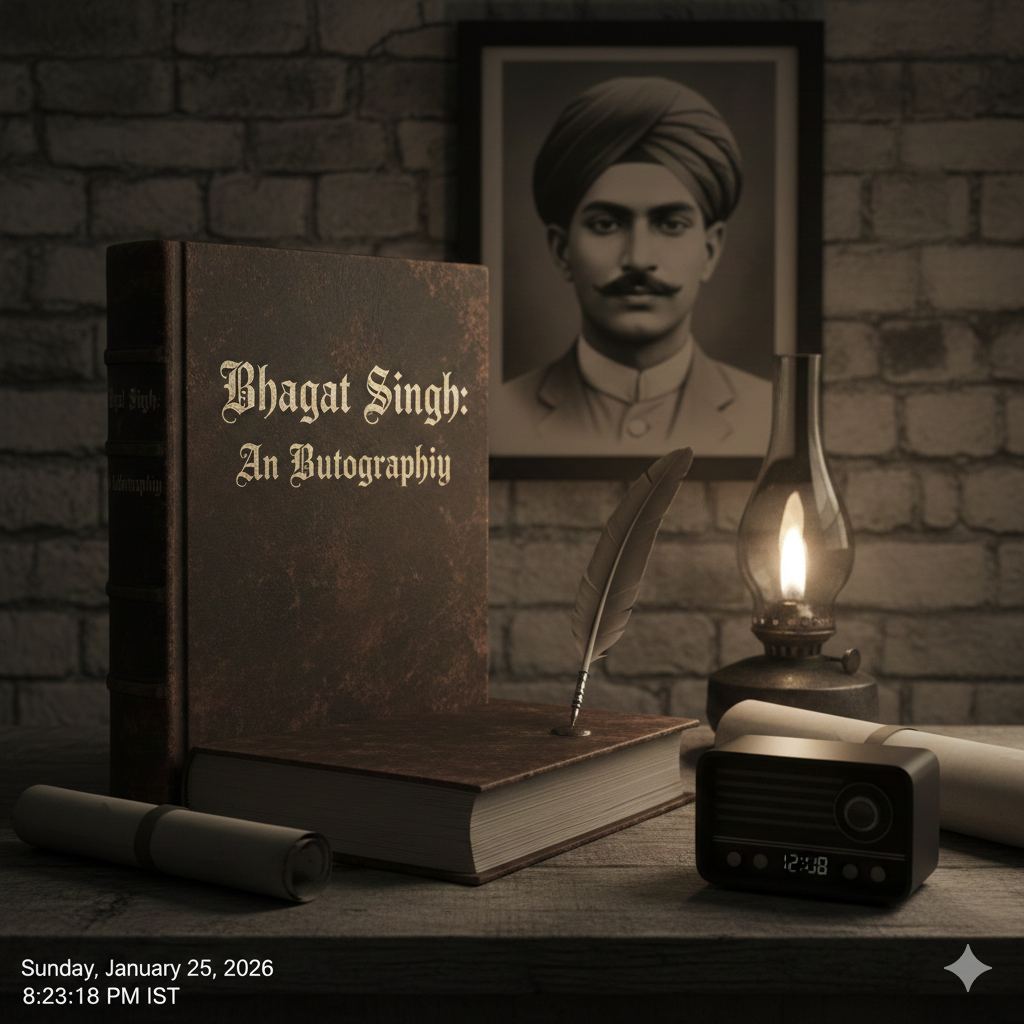
Bhagat Singh is one of the most inspiring figures in Indian history. His life, though short, left a permanent mark on India’s freedom struggle. When people search for Bhagat Singh autobiography, they are not only looking for dates and events, but for the thoughts, ideals, courage, and revolutionary spirit that shaped this fearless patriot. This blog presents an autobiographical-style narrative of Bhagat Singh’s life, drawing from historical records, his writings, letters, and ideology, to help readers understand the man behind the martyr.
Early Life and Childhood Influences
Bhagat Singh was born on 28 September 1907 in Banga village, Lyallpur district (now in Pakistan), into a family deeply involved in India’s struggle for independence. His father, Kishan Singh, and uncles, Ajit Singh and Swaran Singh, were active freedom fighters. From an early age, Bhagat Singh was surrounded by stories of resistance, sacrifice, and nationalism.
Unlike many children of his time, Bhagat Singh grew up with a strong political awareness. The atmosphere in his home was charged with revolutionary ideas. Meetings, discussions on British oppression, and tales of bravery were common. These early influences laid the foundation for his fearless personality and strong sense of justice.
Impact of Jallianwala Bagh Massacre
One of the most defining moments in Bhagat Singh’s early life was the Jallianwala Bagh massacre of 1919. At the age of just 12, Bhagat Singh visited the site in Amritsar where hundreds of innocent Indians were killed by British troops.
He reportedly collected soil soaked with the blood of the victims and preserved it as a symbol of British cruelty. This incident deeply affected him and strengthened his resolve to dedicate his life to the freedom of India. For Bhagat Singh, independence was no longer an abstract idea—it became a personal mission.
Education and Intellectual Growth
Bhagat Singh was a brilliant student with a strong interest in literature, philosophy, and politics. He joined National College in Lahore, which was founded to promote nationalist education free from British influence.
During his college years, Bhagat Singh read extensively. He studied works by Karl Marx, Friedrich Engels, Lenin, and other revolutionary thinkers. These readings shaped his belief in socialism and scientific rationalism. Unlike many revolutionaries who relied solely on emotion, Bhagat Singh believed in ideology, awareness, and intellectual clarity.
He also began writing articles for revolutionary journals, expressing his views on freedom, imperialism, and social injustice. His writing revealed a sharp mind, logical thinking, and a deep concern for India’s future.
Revolutionary Journey Begins
Bhagat Singh’s active involvement in revolutionary activities began when he joined organizations like the Hindustan Republican Association (HRA), which later became the Hindustan Socialist Republican Association (HSRA).
He believed that freedom could not be achieved through petitions and appeals alone. According to Bhagat Singh, revolutionary action was necessary to awaken the masses and challenge British authority. However, his idea of revolution was not blind violence—it was a tool to inspire change and end exploitation.
Protest Against Simon Commission
In 1928, the British government sent the Simon Commission to India without including a single Indian member. This decision led to nationwide protests.
During a protest in Lahore, veteran leader Lala Lajpat Rai was brutally beaten by the police and later died due to injuries. Bhagat Singh, deeply angered by this injustice, decided that those responsible must be held accountable.
Assassination of British Officer Saunders
To avenge the death of Lala Lajpat Rai, Bhagat Singh, along with Rajguru and Sukhdev, planned to assassinate James A. Scott, a British police officer. However, due to mistaken identity, J.P. Saunders, another British officer, was shot instead.
Though this act made Bhagat Singh a wanted revolutionary, he did not go into hiding permanently. Instead, he chose a path that would ensure his message reached the entire nation.
Central Legislative Assembly Bombing
In 1929, Bhagat Singh and Batukeshwar Dutt threw non-lethal bombs in the Central Legislative Assembly in Delhi. The bombs were deliberately designed not to kill anyone. Their aim was symbolic—to “make the deaf hear.”
After throwing the bombs, Bhagat Singh and Dutt did not escape. They courted arrest willingly while shouting revolutionary slogans like “Inquilab Zindabad” and “Long Live the Revolution.”
This act turned Bhagat Singh into a national icon. His calm demeanor, fearless attitude, and powerful slogans inspired millions across India.
Arrest, Hunger Strike, and Prison Life
Bhagat Singh’s time in prison revealed another side of his personality—his commitment to justice and equality. Along with fellow prisoners, he launched a hunger strike demanding equal rights and humane treatment for Indian political prisoners.
The hunger strike lasted for over 100 days, drawing widespread public attention. Despite physical suffering, Bhagat Singh remained mentally strong. He continued reading, writing, and debating ideas with fellow inmates.
His letters from prison reflect deep philosophical thoughts, courage, and clarity about life and death. He never feared execution; instead, he embraced martyrdom if it served the cause of freedom.
Ideology: More Than Just a Revolutionary
The Bhagat Singh autobiography is incomplete without understanding his ideology. He was not only a freedom fighter but also a thinker, socialist, and atheist.
In his famous essay “Why I Am an Atheist,” Bhagat Singh explained his rejection of blind faith and superstition. He believed in reason, science, and human effort rather than divine intervention.
Bhagat Singh envisioned an India free not only from British rule but also from inequality, poverty, caste discrimination, and exploitation. His idea of freedom was deeply connected to social justice.
Trial and Execution
Despite massive public support and appeals for mercy, the British government remained firm. Bhagat Singh, Rajguru, and Sukhdev were sentenced to death.
On 23 March 1931, at the age of just 23, Bhagat Singh was executed. According to accounts, he walked to the gallows smiling, chanting revolutionary slogans, and reading a book on Lenin moments before his death.
His execution sparked outrage across India and strengthened the freedom movement. Though his life ended early, his legacy became immortal.
Legacy and Influence on Modern India
Bhagat Singh remains a symbol of youth power, courage, and sacrifice. His life story continues to inspire students, activists, writers, and leaders.
Even today, his photographs, quotes, and slogans are seen during protests and movements demanding justice and equality. He represents fearless questioning of authority and unwavering commitment to truth.
When people search for Bhagat Singh autobiography, they are often seeking inspiration—a reminder that one individual, armed with courage and conviction, can challenge even the strongest empire.
Why Bhagat Singh’s Life Still Matters
Bhagat Singh’s relevance has not faded with time. His thoughts on nationalism, socialism, secularism, and rationalism are still discussed in modern India.
He teaches us that true patriotism is not blind loyalty but conscious responsibility. His life urges the youth to think critically, act fearlessly, and stand up against injustice.
Conclusion
The story of Bhagat Singh is not just history—it is a powerful autobiography written through actions, sacrifices, and ideals. Though he never penned a traditional autobiography, his letters, essays, and revolutionary acts narrate his life more powerfully than words alone.