Swami Vivekananda Birth and Death: Life, Legacy, and Spiritual Impact
Swami Vivekananda is one of the most influential spiritual leaders India has ever produced. His life, though short, left an indelible mark on Indian philosophy, education, youth empowerment, and global understanding of Vedanta. To truly appreciate his contribution, it is essential to understand Swami Vivekananda’s birth and death, along with the journey between these two defining moments.
This blog explores his early life, spiritual transformation, achievements, philosophy, and the significance of his birth and death in shaping modern India.
Birth of Swami Vivekananda
When and Where Was Swami Vivekananda Born?
Swami Vivekananda was born on 12 January 1863 in Kolkata (then Calcutta), in the Bengal Presidency of British India. His birth anniversary is celebrated across India as National Youth Day, recognizing his immense influence on young minds.
He was born into an educated and progressive Bengali family. His birth name was Narendranath Datta.
Family Background
Swami Vivekananda’s father, Vishwanath Datta, was a successful attorney at the Calcutta High Court. He was known for his rational thinking, liberal outlook, and strong sense of justice. His mother, Bhuvaneshwari Devi, was deeply religious, compassionate, and spiritually inclined.
From his mother, Narendranath inherited spiritual curiosity and moral strength, while from his father, he gained intellectual sharpness and logical reasoning.
Childhood Traits and Early Brilliance
From a very young age, Swami Vivekananda displayed extraordinary intelligence, courage, and leadership qualities. He had a sharp memory and showed keen interest in philosophy, religion, music, gymnastics, and literature.
As a child, he often questioned religious practices and rituals, refusing to accept anything without rational explanation. This inquisitive nature later became the foundation of his spiritual journey.
Education and Intellectual Growth
Narendranath received his early education at the Metropolitan Institution and later joined Scottish Church College in Kolkata. He studied Western philosophy, logic, history, and science, while also exploring Indian scriptures such as the Vedas, Upanishads, and Bhagavad Gita.
Despite his academic excellence, he was deeply troubled by one question:
“Has anyone seen God?”
This question eventually led him to his spiritual mentor.
Spiritual Transformation Under Ramakrishna
Narendranath’s life changed dramatically when he met Ramakrishna Paramahamsa, a mystic saint and priest of the Dakshineswar Kali Temple.
Ramakrishna answered his question with conviction, saying:
“Yes, I have seen God, as clearly as I see you.”
This encounter marked the beginning of Narendranath’s spiritual awakening. Initially skeptical, he eventually became Ramakrishna’s most devoted disciple.
Under his guru’s guidance, Narendranath realized the unity of all religions and experienced spiritual enlightenment. After Ramakrishna’s death in 1886, Narendranath took monastic vows and was given the name Swami Vivekananda.
Life as a Monk and Wanderings Across India
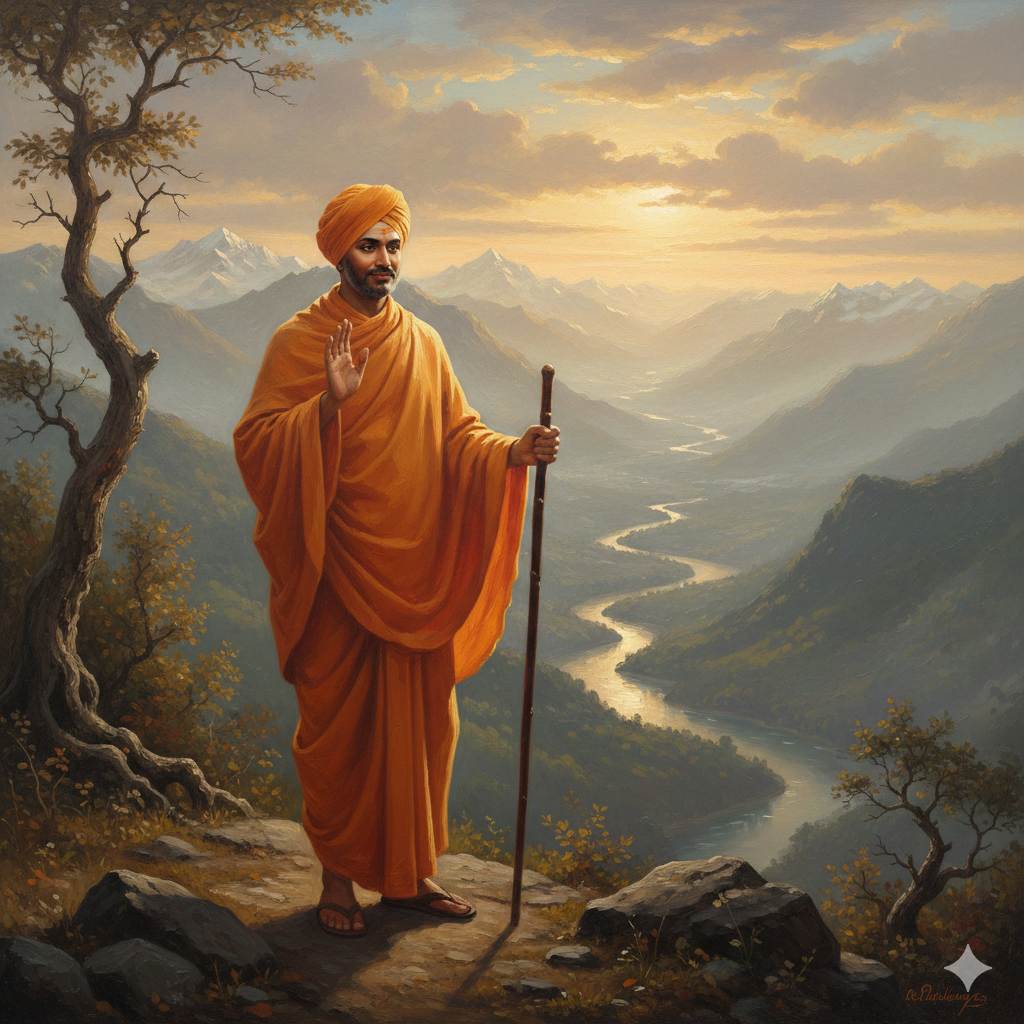
After renouncing worldly life, Swami Vivekananda traveled extensively across India as a wandering monk. These journeys exposed him to the harsh realities of colonial India—poverty, social inequality, illiteracy, and caste discrimination.
He was deeply moved by the suffering of the masses and realized that spirituality must go hand in hand with service to humanity. This realization shaped his mission:
“Serve man as God.”
Global Recognition and the Chicago Address
Parliament of the World’s Religions, 1893
One of the most defining moments of Swami Vivekananda’s life came in 1893, when he represented India at the Parliament of the World’s Religions in Chicago.
His opening words:
“Sisters and Brothers of America…”
received a standing ovation and instantly made him famous worldwide.
Through his speeches, he introduced the world to Vedanta, Yoga, and the idea of religious harmony. He emphasized tolerance, universal brotherhood, and respect for all faiths.
This event elevated India’s spiritual heritage on the global stage and established Swami Vivekananda as a global spiritual ambassador.
Establishment of the Ramakrishna Mission
In 1897, after returning to India, Swami Vivekananda founded the Ramakrishna Mission. The mission aimed to combine spiritual practice with social service.
Its core principles included:
-
Service to the poor and needy
-
Promotion of education
-
Healthcare and disaster relief
-
Spiritual upliftment without discrimination
The Ramakrishna Mission continues to serve humanity across the world and stands as a living legacy of Swami Vivekananda’s ideals.
Philosophy and Teachings
Swami Vivekananda’s teachings were rooted in Vedanta, but he presented them in a modern, practical way.
Key Teachings:
-
Strength is life; weakness is death
-
All religions lead to the same truth
-
Faith in oneself is the foundation of success
-
Education should build character
-
Service to humanity is the highest form of worship
His ideas inspired self-confidence among Indians during colonial rule and encouraged them to reclaim pride in their cultural identity.
Death of Swami Vivekananda
When Did Swami Vivekananda Die?
Swami Vivekananda passed away on 4 July 1902, at the young age of 39, at the Belur Math near Kolkata.
Circumstances of His Death
On the day of his death, he followed his regular routine—meditation, teaching disciples, and spiritual discussions. In the evening, he entered deep meditation and never returned.
Medical experts believe he died due to a rupture of a blood vessel in the brain, though many of his followers believe he consciously chose the time of his departure, as yogis are said to have the power to do.
Significance of Swami Vivekananda’s Birth and Death
Though Swami Vivekananda lived for less than four decades, the period between his birth and death transformed spiritual thinking in India and beyond.
Why His Birth Matters
-
Gave India a modern spiritual leader
-
Inspired youth empowerment
-
Revived Indian philosophy during colonial suppression
Why His Death Matters
-
Marked the completion of a divine mission
-
Left behind strong institutions like the Ramakrishna Mission
-
Inspired generations through his writings and speeches
His life proves that impact is not measured by years lived, but by ideas shared.
Influence on Modern India
Swami Vivekananda deeply influenced leaders like Mahatma Gandhi, Subhas Chandra Bose, and Jawaharlal Nehru. His emphasis on self-belief and national pride played a crucial role in India’s freedom movement.
Today, his teachings continue to guide students, entrepreneurs, spiritual seekers, and social reformers.
Conclusion
Understanding Swami Vivekananda’s birth and death helps us appreciate the extraordinary journey of a man who awakened a nation and enlightened the world. Born as Narendranath Datta in 1863 and leaving his mortal body in 1902, he lived a life dedicated to truth, strength, and service.