
10 Best Career Options After 12th in India (2026)
Passing Class 12 is an important milestone in every student’s life. After completing school, one of the biggest questions students and parents face is: What are the best career options after 12th in India?
The good news is that students today have far more choices than just becoming a doctor, engineer, or government officer. Depending on your interests, subjects, skills, and career goals, you can choose from engineering, healthcare, computer science, finance, law, management, design, artificial intelligence, media, government services, and many other fields.
There is no single “best career” for everyone. The right career depends on your interest, academic background, abilities, financial situation, and long-term goals. Even students from Arts and Humanities have hundreds of degree and professional options available. CBSE’s career guidance material, for example, highlights opportunities across areas such as management, computer applications, design, economics, law, hotel management, mass communication, performing arts, sports, and vocational studies.
In this article, we will discuss the 10 best career options after 12th in India, including the courses you can consider, who they may suit, possible career paths, and important factors to check before choosing a course.
How to Choose the Right Career After 12th?
Before selecting a course, don’t choose a career only because it is popular or because someone else recommends it. A course that works well for one student may not be suitable for another.
Consider these factors before making your decision:
1. Understand Your Interests
Think about the subjects and activities you genuinely enjoy. If you love computers and problem-solving, technology could be a good direction. If you enjoy biology and helping people, healthcare may be more suitable.
2. Consider Your 12th Stream
Your Class 12 subjects can influence which courses you are eligible for. Science, Commerce, and Arts students have different options, although many courses are open to students from multiple streams.
Always check the current eligibility requirements of the specific college and course before applying. Eligibility can vary between institutions.
3. Think About Your Skills
Marks are important, but skills also matter. Communication, analytical thinking, creativity, problem-solving, teamwork, computer skills, and time management can be useful across many careers.
4. Research the Course
Before taking admission, check:
- Course duration
- Eligibility requirements
- Entrance examination requirements
- College or university recognition
- Fees
- Curriculum
- Internship opportunities
- Career paths
- Further study options
5. Think Beyond Salary
Salary is an important consideration, but it should not be the only factor. A career should ideally match your interests and abilities as well as your financial goals.
10 Best Career Options After 12th in India
Here are 10 popular career directions students can consider after Class 12.
1. Engineering and Technology
Engineering remains one of the most popular career options after 12th, particularly for students with a Science background and an interest in mathematics, technology, and problem-solving.
Students can explore areas such as:
- Computer Science Engineering
- Information Technology
- Mechanical Engineering
- Civil Engineering
- Electrical Engineering
- Electronics and Communication
- Chemical Engineering
- Aerospace Engineering
- Artificial Intelligence and Machine Learning
Courses to Consider
Common undergraduate routes include B.Tech and B.E., depending on the institution.
Admission requirements and entrance exams vary by institution and program. Students should always check the current admission notification before applying.
Career Opportunities
After completing an engineering degree, graduates may work in roles such as:
- Software Engineer
- Data Engineer
- Mechanical Engineer
- Civil Engineer
- Electrical Engineer
- Product Engineer
- Systems Engineer
- Network Engineer
- Design Engineer
Technology-related engineering fields can also provide opportunities to work in software, startups, research, consulting, manufacturing, and other industries.
Who Should Consider Engineering?
Engineering may suit students who enjoy:
- Mathematics
- Science
- Technology
- Logical reasoning
- Problem-solving
- Building or designing things
However, students should not choose engineering only because it is considered a “safe” career. Choose a specialization that matches your interests and abilities.
2. Medical and Healthcare Careers
Healthcare is another major career area after 12th, especially for students who have studied Biology.
The medical field is much broader than becoming a doctor. Students can explore multiple healthcare-related education and career paths.
Popular Courses
Depending on eligibility and institution, students may consider:
- MBBS
- BDS
- B.Pharm
- B.Sc Nursing
- Physiotherapy
- Occupational Therapy
- Allied healthcare programs
- Other healthcare-related bachelor’s programs
Students interested in medicine should carefully check the applicable entrance examination and eligibility requirements for the particular course.
Career Opportunities
Healthcare professionals can work in:
- Hospitals
- Clinics
- Diagnostic centres
- Pharmaceutical companies
- Research organisations
- Healthcare technology companies
- Public health organisations
Possible roles vary according to qualification and registration requirements.
Who Should Consider Healthcare?
Healthcare may be suitable for students who:
- Enjoy Biology
- Are interested in human health
- Have patience and discipline
- Like helping people
- Can handle demanding academic schedules
Healthcare education can require significant time and commitment, so students should understand the complete education pathway before choosing a course.
3. Computer Science and Information Technology
Technology has become an important part of almost every industry, making computer science and IT attractive career areas for students.
You don’t necessarily have to become an engineering student to enter the technology sector. Depending on eligibility, students can explore degree programs such as:
- B.Tech Computer Science
- BCA
- B.Sc Computer Science
- B.Sc Information Technology
- Other technology-focused bachelor’s programs
Skills to Learn
Along with a degree, students interested in technology can develop skills such as:
- Programming
- Web development
- Database management
- Cloud computing
- Cybersecurity
- Data analysis
- Software development
- Problem-solving
Career Opportunities
Technology graduates can explore roles such as:
- Software Developer
- Web Developer
- Application Developer
- Database Administrator
- IT Support Specialist
- Cybersecurity Analyst
- Cloud Professional
- Data Analyst
The exact job opportunities depend on the degree, skills, experience, and employer.
Why Consider IT?
One advantage of technology careers is that students can continuously develop their skills through projects, certifications, internships, and practical experience.
4. Chartered Accountancy and Finance
Commerce students who enjoy accounting, taxation, business, and finance can consider professional careers in accounting and finance.
Chartered Accountancy (CA) is one well-known professional path, but it is not the only option available to Commerce students.
Students can also explore areas such as:
- Banking
- Financial analysis
- Investment
- Taxation
- Accounting
- Business finance
- Economics
- Insurance
Courses to Consider
Depending on your career goal, you may consider:
- CA
- B.Com
- BBA Finance
- Economics
- Finance-related certifications
- Other accounting and financial programs
CBSE specifically notes that CA is not the only option for Commerce students and highlights a wide range of degree and certification possibilities across finance, business management, economics, computer applications, law, design, and other fields.
Career Opportunities
Possible career roles include:
- Chartered Accountant
- Accountant
- Financial Analyst
- Tax Consultant
- Investment Professional
- Banking Professional
- Finance Executive
Students should understand the qualification pathway and professional requirements before selecting a regulated professional course.
5. Law
Law is a versatile career option for students who enjoy reading, writing, research, argumentation, public affairs, and analytical thinking.
After Class 12, students can explore integrated undergraduate law programs such as:
- BA LLB
- BBA LLB
- B.Com LLB
- Other integrated law programs
The exact course structure and admission requirements vary by institution.
Career Opportunities in Law
A law graduate may explore areas such as:
- Corporate Law
- Litigation
- Legal Research
- Intellectual Property
- Tax Law
- Compliance
- Legal Consulting
- Public Policy
- Judicial services, subject to applicable requirements
Law can also be useful for students interested in entrepreneurship, business, government, and policy.
Who Should Consider Law?
Law may be suitable if you enjoy:
- Reading
- Writing
- Debate
- Logical reasoning
- Research
- Public speaking
- Understanding rules and regulations
Students should research the specific admission route and professional requirements applicable to their intended legal career.
6. Management and Business
If you are interested in business, entrepreneurship, marketing, leadership, or managing teams, management can be an interesting career direction.
Students can consider undergraduate programs such as:
- BBA
- BMS
- Bachelor-level business programs
- Integrated management programs
Some students later pursue an MBA or another postgraduate qualification.
Career Areas
Management graduates can work in areas such as:
- Marketing
- Sales
- Human Resources
- Operations
- Business Development
- Consulting
- Finance
- Product Management
- Entrepreneurship
Entrepreneurship as a Career
Students interested in starting a business can also use their education to develop knowledge of:
- Business planning
- Marketing
- Finance
- Customer research
- Operations
- Digital tools
Entrepreneurship does not require following one fixed career path, but it does require patience, planning, practical knowledge, and willingness to learn from mistakes.
7. Design and Creative Careers
Students who are creative and enjoy visual communication can explore careers in design and related fields.
Some areas include:
- Fashion Design
- Graphic Design
- Product Design
- Interior Design
- Communication Design
- Animation
- User Experience Design
- Multimedia
- Fine Arts
Courses to Consider
Depending on your interests and eligibility, you may explore:
- B.Des
- Bachelor-level fashion programs
- Fine Arts programs
- Animation and multimedia programs
- Interior design programs
- Other specialised design courses
Some institutes conduct their own entrance examinations or portfolio-based selection processes.
Career Opportunities
Design graduates can work as:
- Graphic Designer
- UX Designer
- Fashion Designer
- Product Designer
- Interior Designer
- Illustrator
- Visual Designer
- Animation Professional
Why Choose Design?
Design can be a good option for students who enjoy creativity, visual thinking, experimentation, and solving problems through design.
A strong portfolio can be particularly valuable in many creative careers.
8. Data Science, Artificial Intelligence and Emerging Technology
Artificial Intelligence, machine learning, data analysis, and related technologies are becoming increasingly important across industries.
Students interested in mathematics, statistics, computers, and analytical problem-solving can explore this area.
Courses to Consider
Depending on eligibility, students can consider programs related to:
- Computer Science
- Data Science
- Artificial Intelligence
- Machine Learning
- Statistics
- Mathematics
- Information Technology
Some students enter these fields through a broader bachelor’s degree and later specialise through postgraduate study, certifications, or practical projects.
Important Skills
Students interested in this field can develop:
- Mathematics
- Statistics
- Python or other programming languages
- Data analysis
- Machine learning fundamentals
- Problem-solving
- Communication skills
Career Opportunities
Potential roles include:
- Data Analyst
- Data Scientist
- AI Engineer
- Machine Learning Engineer
- Business Intelligence Analyst
- Data Engineer
The field is competitive, so students should focus on practical skills and projects instead of relying only on a course title.
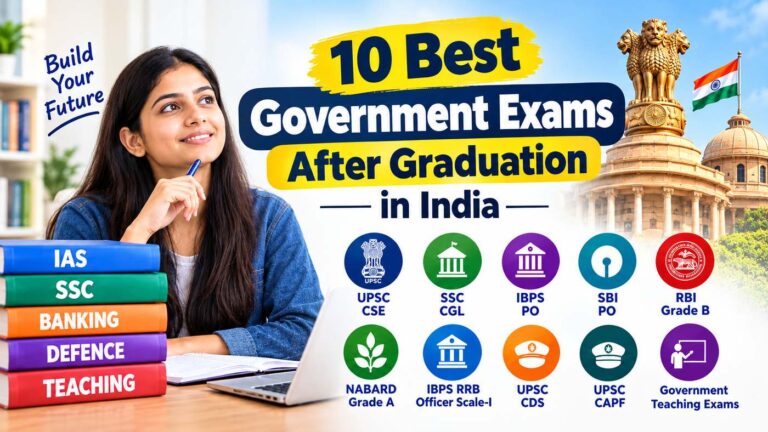
9. Government Jobs and Competitive Exams
Government careers continue to attract many students because of the variety of roles available across central and state government organisations.
However, students should understand an important point: many major government competitive examinations require graduation, so completing Class 12 does not automatically qualify you for every government career.
The Central Government’s National Career Service provides career counselling, vocational guidance, skill-development information, apprenticeships, internships, and employment-related services.
Possible Career Directions
Depending on qualification and the relevant recruitment notification, students can explore areas such as:
- Defence
- Banking
- Railways
- Staff selection examinations
- State government services
- Civil services
- Police services
- Teaching
- Technical government roles
For example, students interested in civil services generally need to complete graduation before appearing for the relevant examination.
How to Prepare?
A student planning a government career can start by:
- Understanding the examination requirements.
- Choosing an appropriate graduation course.
- Developing general knowledge.
- Improving reasoning and quantitative aptitude.
- Building strong communication skills.
- Following official examination notifications.
Always verify eligibility, age limits, syllabus, and exam dates from the official recruitment authority.
10. Journalism, Media and Communication
For students who enjoy writing, storytelling, communication, photography, video, social media, or current affairs, media and communication can be an exciting career area.
Courses to Consider
Students can explore:
- Journalism
- Mass Communication
- Media Studies
- Public Relations
- Advertising
- Digital Media
- Film and Television
- Communication Studies
Career Opportunities
Graduates may explore roles such as:
- Journalist
- Content Writer
- Copywriter
- Social Media Executive
- Public Relations Professional
- Video Producer
- News Researcher
- Digital Content Creator
- Communication Executive
The growth of websites, social media, podcasts, online video, and digital publishing has created many different forms of media work.
Skills That Matter
Students can develop:
- Writing
- Communication
- Research
- Editing
- Video production
- Photography
- Social media skills
- Storytelling
Building a portfolio through internships, personal projects, blogs, videos, or other work can help demonstrate practical ability.
Career Options After 12th Science
Science students generally have a wide range of choices because their subjects can lead to technical, medical, research, and other fields.
Popular Options
- Engineering
- Medicine
- Dentistry
- Pharmacy
- Nursing
- Computer Science
- IT
- Data Science
- Artificial Intelligence
- Architecture
- Biotechnology
- Pure Sciences
- Defence
- Design
- Management
- Law
Students should not assume that Science means they must become an engineer or doctor. Your interests and long-term goals should guide the decision.
Career Options After 12th Commerce
Commerce students can explore careers in finance, accounting, business, management, economics, law, technology, and many other areas.
Popular Options
- Chartered Accountancy
- B.Com
- BBA
- Finance
- Economics
- Banking
- Investment and financial services
- Company-related professional careers
- Law
- Digital Marketing
- Business Analytics
- Entrepreneurship
- Management
There are many more choices than CA alone. CBSE’s career guidance material also lists diverse areas open to Commerce students.
Career Options After 12th Arts
Arts or Humanities students have a broad range of career choices as well.
Popular Options
- BA
- Law
- Journalism
- Mass Communication
- Psychology
- Economics
- Sociology
- Political Science
- History
- Design
- Hotel Management
- Teaching
- Social Sciences
- Public Policy
- Management
- Civil services preparation
Students should not consider Arts a limited stream. Career opportunities depend heavily on the subjects selected, skills developed, higher education, and career planning.
High-Salary Career Options After 12th
Many students search for the “highest salary career after 12th.” However, it is difficult to guarantee a particular salary because income varies significantly based on qualification, college, skills, experience, location, industry, employer, and performance.
Career paths that can potentially lead to strong earning opportunities include:
- Software and technology
- Artificial Intelligence and data-related careers
- Medicine
- Finance
- Chartered Accountancy
- Corporate law
- Management
- Product and UX design
- Entrepreneurship
Instead of choosing a career solely because someone claims it offers a high salary, compare the education required, difficulty level, cost, career growth, job opportunities, and your own interest.
How to Choose the Best Course After 12th?
Use this simple checklist before taking admission:
Step 1: Identify Your Interests
Write down the subjects and activities you enjoy.
Step 2: Identify Your Strengths
Ask yourself whether your strengths are more related to mathematics, science, communication, creativity, business, analysis, or practical work.
Step 3: Research Multiple Careers
Don’t stop after researching one career. Compare at least three to five options.
Step 4: Check Eligibility
Visit the official website of the college, university, examination authority, or professional body to verify the latest eligibility rules.
Step 5: Compare Colleges
Look at accreditation/recognition, curriculum, faculty, facilities, internships, fees, location, and student support.
Step 6: Consider the Total Cost
Don’t only consider tuition fees. Include accommodation, transportation, books, examination fees, equipment, and other expenses.
Step 7: Look at Career Growth
Understand what you can do after graduation. Can you work, pursue a master’s degree, take professional certifications, or start a business?
Step 8: Talk to the Right People
Career counsellors, teachers, professionals, and current students can provide useful perspectives.
The National Career Service is also designed to provide career counselling, vocational guidance, skill-development information, and employment-related services.
Common Mistakes Students Make After 12th
Choosing a career is a major decision, so avoid these common mistakes.
Choosing a Career Because of Friends
Your friend’s interests may be completely different from yours. Don’t choose a course simply because your friends are joining it.
Choosing Only for Salary
A high-paying career may require years of education, intense competition, or specific skills. Make sure the career suits you.
Ignoring Course Eligibility
Always check official eligibility criteria before applying. Different institutions can have different requirements.
Choosing a College Without Research
Don’t select a college based only on advertisements or social media. Research its recognition, course structure, fees, placement information, and reputation.
Ignoring Skills
A degree is important, but practical skills, communication, internships, projects, and experience can also influence career opportunities.
Following Family Pressure Without Discussion
Parents often want the best for their children, but career decisions should involve an honest conversation about the student’s interests and abilities.
Frequently Asked Questions
1. Which is the best career option after 12th in India?
There is no single best career for everyone. Engineering, healthcare, technology, finance, law, management, design, government services, and media are among the many career directions students can explore.
2. Which career is best after 12th Science?
Science students can consider engineering, medicine, pharmacy, computer science, IT, architecture, data science, AI, pure sciences, biotechnology, and several other fields.
3. Which career is best after 12th Commerce?
Commerce students can consider CA, B.Com, finance, banking, economics, BBA, management, law, business analytics, entrepreneurship, and other professional fields.
4. What can I do after 12th Arts?
Arts students can explore law, journalism, psychology, economics, design, management, teaching, social sciences, public policy, media, and many other fields.
5. Is CA the only option after 12th Commerce?
No. CA is only one career path. Commerce students have many degree and professional options across finance, business, economics, management, law, technology, and other areas.
6. Can Science students pursue law?
Yes, students from different educational backgrounds can pursue law, subject to the eligibility requirements of the particular law program and institution.
7. Can I pursue a career in AI after 12th?
Yes. Students can consider computer science, AI, data science, mathematics, statistics, or related undergraduate programs and then develop specialised skills through projects and further education.
8. I get a government job immediately after 12th?
Some government recruitment opportunities are available at the 12th-pass level, but many major competitive examinations require graduation. Always check the official recruitment notification for the exact qualification requirements.
9. Should I choose a degree or a professional course?
It depends on your career goal. A degree can provide broad academic knowledge, while a professional course may focus more specifically on a profession. In some cases, students can combine a degree with professional certifications.
10. How can I know which career is right for me?
Start by evaluating your interests, strengths, subjects, financial situation, preferred lifestyle, and long-term goals. Career counselling and aptitude assessments can also help you make a more informed decision.
Final Thoughts
Choosing the right career after Class 12 can feel confusing because there are so many options. The most important thing to remember is that there is no universal “best career option after 12th.”
The best career is one that matches your interest, skills, education, goals, and willingness to learn.
Whether you are from Science, Commerce, or Arts, you have multiple paths available. Engineering, healthcare, IT, finance, law, management, design, AI, government careers, and media are only some of the possibilities.
Take your time, research different courses, compare colleges, check official eligibility requirements, and avoid making a decision only because of social pressure or salary claims.
Most importantly, remember that your first course does not necessarily define your entire life. Careers can evolve as you gain education, skills, experience, and a better understanding of what you enjoy.
Choose a career based on informed decision-making rather than comparison. Your interests and consistent effort can play a much bigger role in long-term success.