
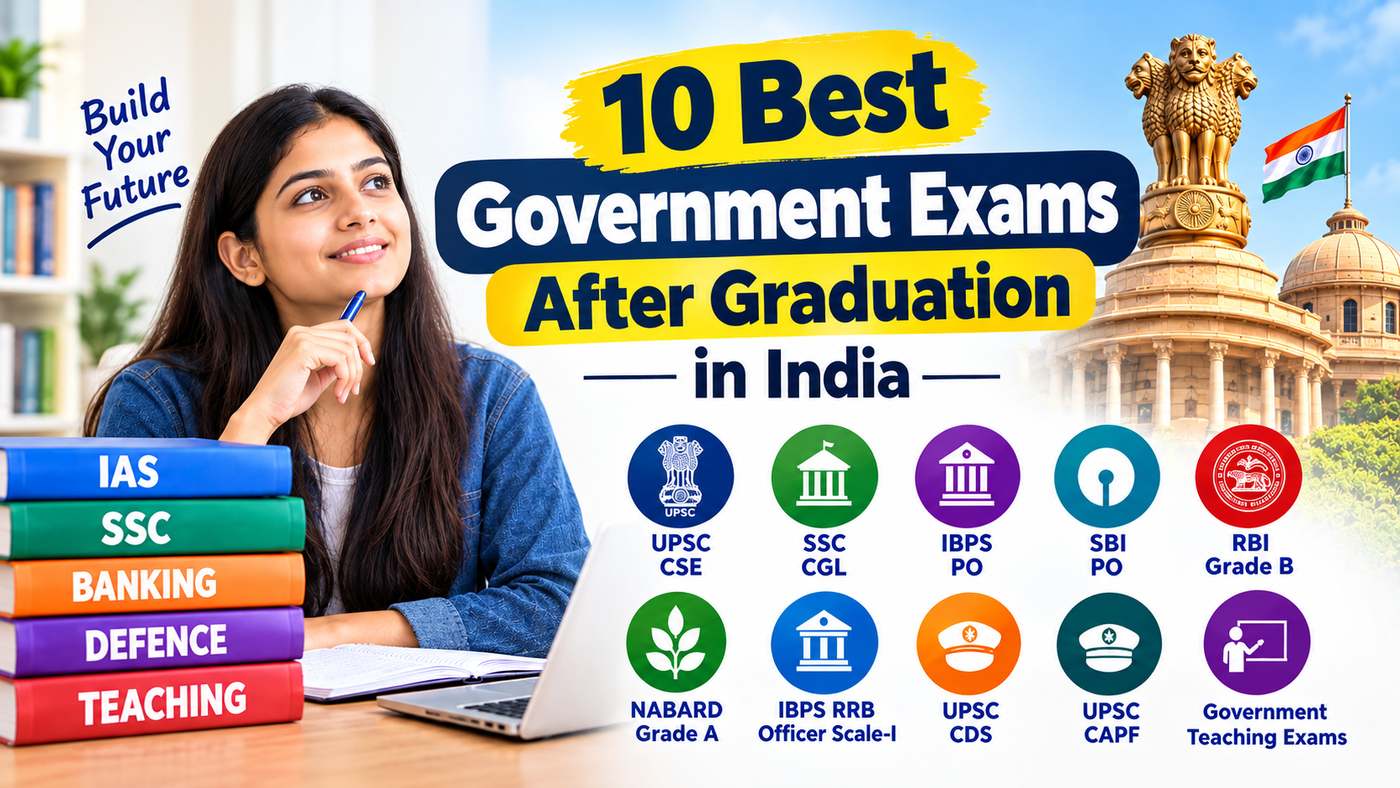
10 Best Government Exams After Graduation in India
Introduction
After completing graduation, students have several career options available to them. Along with private-sector jobs, government jobs remain one of the most popular career choices in India because of factors such as job stability, career growth, allowances, social status, and long-term benefits.
There are many competitive government exams that graduates can apply for. Some of the most popular options include UPSC Civil Services, SSC CGL, IBPS PO, SBI PO, RBI Grade B, NABARD Grade A, IBPS RRB, UPSC CDS, UPSC CAPF, and government teaching examinations.
If you have completed your graduation and are planning to prepare for a government job, choosing the right examination is important. You should consider your educational qualification, interests, age eligibility, career goals, and the syllabus before selecting an exam.
In this article, we will discuss the 10 best government exams after graduation in India, including their eligibility, selection process, career opportunities, and preparation tips.
1. UPSC Civil Services Examination
The UPSC Civil Services Examination (CSE) is one of the most prestigious and competitive government examinations in India. It provides candidates with opportunities to join services such as the Indian Administrative Service (IAS), Indian Police Service (IPS), Indian Foreign Service (IFS), and several other central services.
UPSC conducts the Civil Services Examination every year according to its official examination schedule.
Eligibility
Candidates generally need a bachelor’s degree from a recognized university to apply for the Civil Services Examination.
Graduation can usually be completed in any discipline, subject to the eligibility conditions mentioned in the official notification.
Candidates must also satisfy the prescribed age limit and other conditions. Since these requirements can change, applicants should always check the latest UPSC notification before applying.
Selection Process
The Civil Services Examination generally consists of three stages:
- Civil Services Preliminary Examination
- Civil Services Main Examination
- Personality Test/Interview
The Preliminary Examination is used as a screening stage, while the final selection is based on the applicable stages of the Main Examination and Personality Test.
Career Opportunities
Successful candidates can enter prestigious services such as:
- IAS
- IPS
- Indian Foreign Service
- Indian Revenue Service
- Other Central Government Services
Who Should Choose UPSC CSE?
UPSC CSE can be a suitable choice for candidates interested in administration, public service, leadership, policymaking, and national development.
2. SSC Combined Graduate Level Examination
The Staff Selection Commission Combined Graduate Level (SSC CGL) Examination is one of the most popular government examinations for graduates in India.
SSC CGL is conducted for recruitment to various positions in Central Government departments, ministries, and offices.
Eligibility
For many SSC CGL posts, candidates need a bachelor’s degree from a recognized university or institution.
However, specific posts may have additional educational or other requirements. Candidates should therefore check the latest SSC CGL notification for post-wise eligibility.
Important Subjects
Candidates preparing for SSC CGL generally need to focus on:
- Quantitative Aptitude
- Reasoning
- English
- General Awareness
Career Opportunities
SSC CGL can provide opportunities for various Central Government positions in different departments and offices.
Why Choose SSC CGL?
SSC CGL is a good option for graduates who want a Central Government job and prefer an examination with a syllabus covering areas such as mathematics, reasoning, English, and general awareness.
3. IBPS PO
The IBPS Probationary Officer (PO) Examination is an important examination for graduates interested in a career in the banking sector.
The Institute of Banking Personnel Selection conducts recruitment processes for participating public-sector banks through its Common Recruitment Process.
Eligibility
Candidates generally need a bachelor’s degree from a recognized university or equivalent qualification.
Applicants must also meet the age limit and other conditions mentioned in the current recruitment notification.
Selection Process
The IBPS PO selection process generally includes:
- Preliminary Examination
- Main Examination
- Interview
The exact process and requirements should always be checked in the latest official notification.
Important Subjects
Candidates should focus on:
- Reasoning Ability
- Quantitative Aptitude
- English Language
- General Awareness
- Banking Awareness
Career Growth
A Probationary Officer can build a long-term career in banking and move into managerial and senior banking positions through experience and internal promotion opportunities.
Who Should Choose IBPS PO?
IBPS PO can be a good choice for graduates who are interested in banking, finance, customer service, and management.
4. SBI PO
The State Bank of India Probationary Officer (SBI PO) Examination is another highly popular banking examination for graduates.
SBI PO offers candidates an opportunity to begin an officer-level career with State Bank of India.
Eligibility
Candidates generally need a graduation degree in any discipline from a recognized university or an equivalent qualification, subject to the conditions mentioned in the current SBI PO notification.
Selection Process
The selection process generally includes:
- Preliminary Examination
- Main Examination
- Interview and/or other applicable selection stages
The exact selection procedure may vary according to the recruitment notification.
Preparation Strategy
Candidates preparing for SBI PO should regularly practice:
- Quantitative Aptitude
- Reasoning
- English
- Current Affairs
- Banking Awareness
- Mock Tests
Career Scope
SBI PO provides opportunities for professional growth in banking operations, customer management, finance, loans, and other banking functions.
Who Should Choose SBI PO?
SBI PO is suitable for graduates who want to build a career in the banking sector and are interested in officer-level responsibilities.
5. RBI Grade B
The RBI Grade B Examination is conducted for officer-level recruitment in the Reserve Bank of India.
It is considered one of the important career opportunities for graduates interested in banking, economics, finance, and financial regulation.
Eligibility
For the General stream, candidates generally need a bachelor’s degree or equivalent qualification along with the minimum marks and other requirements specified in the recruitment notification.
Different streams may have different educational requirements.
Important Subjects
RBI Grade B preparation generally involves subjects such as:
- Quantitative Aptitude
- Reasoning
- English
- General Awareness
- Economics
- Finance
- Banking and Financial System
Selection Process
The recruitment process generally includes multiple examination phases followed by an interview, depending on the particular post and recruitment notification.
Career Opportunities
An RBI officer can work in areas related to banking regulation, financial systems, economic analysis, monetary policy, and other important functions of the central bank.
Who Should Choose RBI Grade B?
RBI Grade B can be an excellent option for candidates who have a strong interest in economics, finance, banking, and the Indian financial system.
6. NABARD Grade A
The NABARD Grade A Examination is an important career option for candidates interested in rural development, agriculture, banking, and financial services.
NABARD plays an important role in the development of India’s agriculture and rural economy.
Eligibility
Eligibility for NABARD Grade A varies depending on the post and discipline.
Some positions may require specific educational qualifications, while other positions may have different requirements.
Candidates should carefully read the latest NABARD recruitment notification before applying.
Selection Process
The selection process generally includes:
- Preliminary Examination
- Main Examination
- Interview
The exact structure can vary depending on the recruitment cycle and position.
Important Preparation Areas
Candidates may need to prepare:
- Reasoning
- Quantitative Aptitude
- English
- General Awareness
- Economic and Social Issues
- Agriculture and Rural Development
Career Scope
NABARD offers career opportunities related to rural finance, agriculture development, financial inclusion, and rural economic development.
Who Should Choose NABARD Grade A?
This examination can be a good choice for graduates who are interested in agriculture, rural development, banking, and economic development.
7. IBPS RRB Officer Scale-I
The IBPS RRB Officer Scale-I Examination is a popular option for graduates interested in working in Regional Rural Banks.
Regional Rural Banks focus on providing banking and financial services, particularly in rural and semi-urban areas.
Eligibility
Candidates generally need a bachelor’s degree from a recognized university or institution.
Depending on the recruitment notification and participating bank, proficiency in a local language may also be an important requirement.
Selection Process
The recruitment process generally includes:
- Preliminary Examination
- Main Examination
- Interview
Candidates should check the latest official notification for the exact selection process.
Career Opportunities
An Officer Scale-I can work in areas such as:
- Banking operations
- Loans and credit
- Customer services
- Deposits
- Financial services
- Rural banking
Who Should Choose IBPS RRB?
This examination can be suitable for graduates who are interested in banking and want to work in rural or semi-urban areas.
8. UPSC Combined Defence Services Examination
The UPSC Combined Defence Services (CDS) Examination is an important option for graduates who want to build a career as an officer in the Indian Armed Forces.
The examination provides opportunities for eligible candidates to join defence academies, subject to the educational, age, physical, and other requirements of the respective academy.
Eligibility
Educational qualifications vary according to the academy and course.
Candidates also need to meet prescribed age, nationality, marital status, physical, and medical requirements.
Selection Process
The selection process generally includes:
- Written Examination
- SSB Interview
- Medical Examination
Career Opportunities
Eligible candidates can pursue officer-level careers in the Indian Army and other defence services through the respective CDS entry routes.
Who Should Choose CDS?
CDS is a suitable option for graduates who are interested in:
- Defence services
- Leadership
- Discipline
- Physical fitness
- National service
9. UPSC CAPF Assistant Commandant
The UPSC Central Armed Police Forces (CAPF) Assistant Commandant Examination is another excellent option for graduates interested in a uniformed government career.
Through this examination, eligible candidates can compete for Assistant Commandant positions in Central Armed Police Forces.
Eligibility
Candidates generally need a bachelor’s degree from a recognized university or institution.
They must also meet the prescribed age, physical standards, medical requirements, and other eligibility conditions.
Selection Process
The selection process generally involves:
- Written Examination
- Physical Standards/Physical Efficiency Tests
- Medical Examination
- Interview/Personality Test
Career Opportunities
Selected candidates can work in leadership and operational roles within the Central Armed Police Forces.
Who Should Choose CAPF?
CAPF can be a good option for graduates who want:
- A uniformed government career
- Leadership responsibilities
- Physical and challenging work
- A career in public security
10. Government Teaching Exams
Government teaching is another popular career option after graduation. However, teaching eligibility depends heavily on the specific post, subject, state, and recruitment authority.
Candidates may have opportunities through state-level teacher recruitment examinations, teacher eligibility tests, and subject-specific recruitment processes.
Eligibility
Graduation alone may not be sufficient for every government teaching position.
Depending on the post, candidates may need qualifications such as:
- B.Ed.
- D.El.Ed.
- Teacher Eligibility Test qualification
- Relevant subject qualification
- Other prescribed qualifications
Career Opportunities
Depending on the qualification and recruitment rules, candidates may pursue positions such as:
- Assistant Teacher
- School Teacher
- Subject Teacher
- Lecturer
- Faculty
Who Should Choose Government Teaching?
Teaching can be a good career choice for graduates who enjoy education, teaching, communication, and working with students.
Quick Comparison of Government Exams After Graduation
| Exam | Main Career Area | Graduation Required |
|---|---|---|
| UPSC Civil Services | Administration & Civil Services | Yes |
| SSC CGL | Central Government Departments | Yes for applicable graduate posts |
| IBPS PO | Banking | Yes |
| SBI PO | Banking | Yes |
| RBI Grade B | Banking & Finance | Yes, with prescribed requirements |
| NABARD Grade A | Rural Development & Banking | Post-specific |
| IBPS RRB Officer Scale-I | Rural Banking | Yes |
| UPSC CDS | Defence | Academy-specific |
| UPSC CAPF AC | Central Armed Police Forces | Yes |
| Government Teaching Exams | Education | Post-specific |
Note: Eligibility, age limits, vacancies, examination patterns, and selection stages may change. Always check the latest official notification before applying.
How to Choose the Best Government Exam After Graduation?
There is no single government exam that is best for every graduate. Your choice should depend on your interests, educational background, strengths, and long-term career goals.
1. Check Your Educational Qualification
First, check whether your graduation degree meets the eligibility requirements of your preferred examination.
Many exams accept graduates from different disciplines, while specialist positions may require a specific degree or subject.
2. Decide Your Career Goal
Your career goal should play an important role in selecting an examination.
For example:
- Interested in administration? Consider UPSC Civil Services.
- Interested in Central Government departments? Consider SSC CGL.
- Interested in banking? Consider SBI PO or IBPS PO.
- Interested in finance and economics? Consider RBI Grade B.
- Interested in rural development? Consider NABARD Grade A.
- Interested in defence? Consider CDS.
- Interested in a uniformed security career? Consider CAPF.
- Interested in teaching? Explore relevant government teaching examinations.
3. Compare the Syllabus
Compare the syllabus of two or three exams before deciding where to focus your preparation.
Some examinations have overlapping subjects, which can allow candidates to prepare for more than one examination efficiently.
4. Check Previous Year Papers
Solving previous year question papers helps you understand:
- Question patterns
- Difficulty level
- Important topics
- Time requirements
- Your weak areas
5. Take Regular Mock Tests
Mock tests can help improve your speed, accuracy, time management, and confidence.
Government Exam Preparation Tips After Graduation
Create a Realistic Study Plan
Create a daily timetable based on your target examination. Divide your available study time between different subjects.
Build Strong Fundamentals
Before moving to advanced questions, make sure your basic concepts in mathematics, reasoning, English, and general awareness are clear.
Stay Updated With Current Affairs
Current affairs are important for many government examinations. Follow reliable news sources and revise important events regularly.
Practice Previous Year Questions
Previous year papers should be an important part of your preparation. They help you understand the actual examination pattern.
Take Mock Tests Regularly
Do not wait until the final month to start taking mock tests. Regular practice can help you identify your strengths and weaknesses.
Revise Regularly
Revision is just as important as learning new topics. Maintain short notes and revise important concepts regularly.
Common Mistakes to Avoid During Government Exam Preparation
1. Preparing for Too Many Exams
Preparing for too many unrelated examinations at the same time can make your preparation unfocused.
Choose exams with similar syllabuses whenever possible.
2. Not Following a Study Schedule
An inconsistent study routine can slow down your preparation. Create a realistic schedule that you can follow consistently.
3. Ignoring Mock Tests
Mock tests are important for understanding your performance and improving time management.
4. Not Reading the Official Notification
Never depend only on third-party websites for eligibility information.
Always check the official notification for:
- Age limit
- Educational qualification
- Vacancies
- Application dates
- Examination dates
- Selection process
5. Not Revising
Studying new topics without regular revision can reduce retention. Make revision a regular part of your preparation.
Frequently Asked Questions
1. Which is the best government exam after graduation in India?
The best government examination depends on your career goals. UPSC CSE is suitable for candidates interested in civil services, SSC CGL for many Central Government positions, banking aspirants can consider IBPS PO or SBI PO, and defence aspirants can consider CDS or CAPF.
2. Can I apply for government exams after any graduation degree?
Many government examinations accept candidates with a bachelor’s degree in any discipline. However, some specialist positions require specific educational qualifications.
Always check the latest official notification before applying.
3. Is SSC CGL a good option after graduation?
Yes. SSC CGL is a popular option for graduates who want to work in various Central Government departments and offices.
4. Is UPSC Civil Services difficult?
UPSC Civil Services is highly competitive and has a broad syllabus with multiple stages. Consistent preparation, revision, current affairs knowledge, and answer-writing practice are important.
5. Which government exam is best for banking jobs?
IBPS PO, SBI PO, RBI Grade B, NABARD Grade A, and IBPS RRB are important examinations for different types of banking and financial-sector careers.
6. Can final-year students apply for government exams?
Some government examinations allow final-year students to apply under specific conditions, while others require candidates to possess their degree by a particular date.
Always check the current official notification.
7. How should I start preparing for government exams after graduation?
Start by selecting a target examination. Download and understand the syllabus, study previous year papers, create a daily timetable, build your fundamentals, and gradually include mock tests and regular revision.
7. How much time is required to prepare for government exams?
Preparation time varies from person to person and depends on the examination, syllabus, competition, and your existing knowledge. Some candidates may need several months, while highly competitive examinations may require a longer preparation period.
Conclusion
Graduation opens the door to several government career opportunities in India. UPSC Civil Services, SSC CGL, IBPS PO, SBI PO, RBI Grade B, NABARD Grade A, IBPS RRB Officer Scale-I, UPSC CDS, UPSC CAPF, and government teaching examinations are among the important options graduates can explore.