
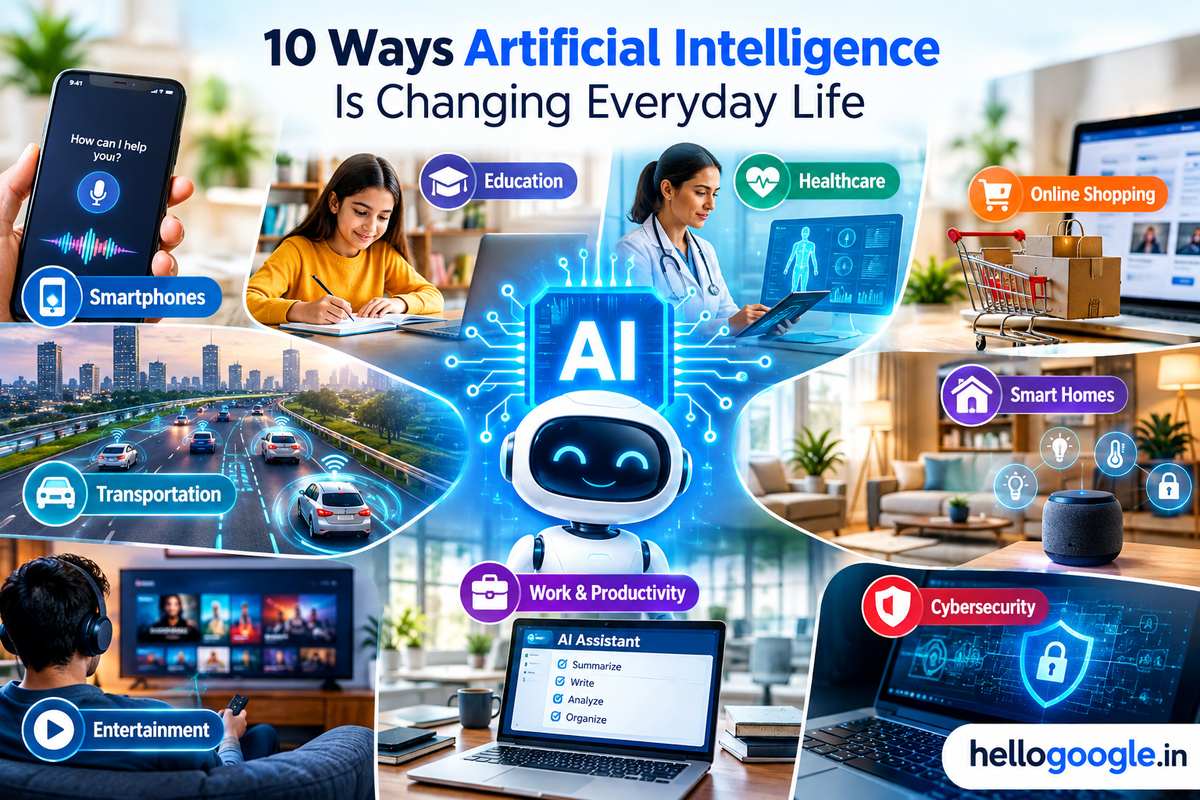
10 Ways Artificial Intelligence Is Changing Everyday Life in 2026
Artificial Intelligence (AI) has moved from being a futuristic concept to becoming a practical part of everyday life. Many people use AI-powered technology every day without even realizing it. From voice assistants and personalized recommendations to navigation apps and online customer support, artificial intelligence is quietly helping people complete tasks faster and make digital services more useful.
The growth of AI is also changing how people learn, work, communicate, shop, travel, and manage their daily routines. Businesses are using AI to analyze information and automate repetitive tasks, while consumers are benefiting from smarter applications and personalized digital experiences.
In 2026, AI continues to develop rapidly, with new applications appearing across smartphones, computers, homes, education, healthcare, transportation, entertainment, and many other areas.
In this article, we will explore 10 important ways artificial intelligence is changing everyday life and how these technologies may affect the way we use digital services.
What Is Artificial Intelligence?
Artificial Intelligence is a field of technology that enables computer systems to perform tasks that normally require some form of human intelligence. These tasks can include recognizing patterns, understanding language, analyzing information, generating content, making predictions, and responding to questions.
AI systems can process large amounts of data and identify patterns that may be difficult for humans to detect manually. Modern AI applications can also understand text, images, audio, and other forms of information.
AI does not simply mean robots. In fact, many AI systems operate behind the scenes in applications and online services that people already use.
1. AI Is Making Smartphones Smarter
Smartphones are among the most common places where people encounter artificial intelligence.
Modern smartphones use AI for features such as voice recognition, photography, security, translation, battery optimization, and personalized suggestions.
AI-Powered Smartphone Cameras
AI can automatically identify objects, faces, lighting conditions, and scenes. A smartphone camera may adjust exposure, color, focus, and other settings automatically to improve the final image.
For example, when you photograph a landscape, food, or a person, AI-powered camera software can recognize the type of scene and optimize the image accordingly.
Voice Assistants
Voice assistants allow users to interact with their devices using natural language. People can use voice commands to set reminders, search for information, send messages, control compatible devices, or perform other tasks.
This makes smartphones more convenient, particularly when users cannot easily type on a screen.
2. AI Is Changing the Way People Search for Information
Search engines have traditionally provided users with lists of web pages based on their queries. AI is increasingly being used to understand the meaning behind questions and provide more conversational ways to find information.
Instead of using short keywords, users can ask detailed questions in natural language.
More Personalized Information
AI systems can analyze the context of a question and help users find relevant information more efficiently. This can be particularly useful when someone needs an explanation rather than simply a list of links.
For example, a student might ask an AI-powered system to explain a difficult concept in simple language or provide examples related to a particular subject.
However, users should still verify important information because AI-generated responses can sometimes contain errors or outdated information.
3. AI Is Transforming Education
Education is another area where artificial intelligence is having a noticeable impact.
Students can use AI-powered learning applications to understand difficult topics, practice languages, generate study questions, summarize information, and receive explanations.
Personalized Learning
Traditional classrooms often require teachers to work with students who have different learning speeds and abilities. AI-powered educational tools can provide personalized exercises and explanations based on a learner’s needs.
For example, a student struggling with mathematics can use an AI-based learning application to receive additional explanations and practice questions.
Support for Teachers
AI can also help teachers with administrative and educational tasks. Depending on the tool, it may assist with creating lesson plans, preparing quizzes, organizing information, or generating educational materials.
AI should be treated as a supporting technology rather than a replacement for teachers. Human guidance remains important for understanding students and providing meaningful education.
4. AI Is Improving Healthcare Services
Artificial intelligence is increasingly being explored and used in healthcare for areas such as medical research, image analysis, administrative work, and patient support.
Medical Data Analysis
Healthcare organizations generate large amounts of information. AI systems can help analyze certain types of data and identify patterns that may deserve further attention.
AI-based image analysis can also assist trained medical professionals in examining certain medical images.
Administrative Assistance
AI can help automate repetitive administrative tasks, such as organizing information, scheduling processes, and handling routine communications.
This can potentially allow healthcare professionals to spend more time on patient care.
It is important to remember that AI tools are not a substitute for qualified medical professionals. People should consult appropriate healthcare providers for diagnosis and treatment decisions.
5. AI Is Making Online Shopping More Personalized
Online shopping platforms use AI to understand customer behavior and provide more relevant experiences.
When people browse products, search for items, or purchase something online, recommendation systems may analyze patterns in their activity.
Product Recommendations
AI-powered recommendation systems can suggest products that may be relevant to a customer’s interests.
For example, someone who frequently searches for fitness equipment may see recommendations related to exercise accessories, sports clothing, or other relevant products.
Customer Service
Many online businesses also use AI-powered chat systems to answer common questions. These systems can provide information about orders, returns, products, and other routine issues.
For complicated problems, customers may still need assistance from a human representative.
6. AI Is Making Navigation and Transportation Smarter
Navigation applications have become an essential part of daily travel, and AI plays an important role in making these services more useful.
AI-powered systems can analyze traffic information, road conditions, historical patterns, and other data to help estimate travel times and recommend routes.
Smarter Route Planning
When traffic conditions change, navigation applications can suggest alternative routes. This can help drivers avoid congestion and potentially reduce travel time.
AI is also being used in transportation research, including areas related to autonomous driving and intelligent traffic management.
Public Transportation
AI can potentially help transportation organizations analyze passenger patterns and improve scheduling and resource planning.
As cities collect more transportation data, AI may become increasingly important in managing complex urban mobility systems.
7. AI Is Changing Entertainment
Entertainment platforms are using artificial intelligence to personalize what users see and discover.
Streaming services, music applications, social platforms, and other digital entertainment products can use recommendation algorithms to suggest content.
Personalized Recommendations
If you frequently watch a particular type of movie or listen to a certain genre of music, an AI-powered recommendation system may suggest similar content.
This can help users discover new entertainment without manually searching through thousands of options.
AI-Generated Content
Generative AI is also changing how people create images, text, audio, video, and other forms of digital content.
Creators can use AI tools to brainstorm ideas, generate drafts, edit material, or experiment with different creative concepts.
However, users should understand the copyright, originality, and platform rules that may apply to AI-generated content.
8. AI Is Helping People Work More Efficiently
AI is increasingly becoming a workplace productivity tool.
Professionals can use AI applications to summarize documents, organize information, brainstorm ideas, analyze data, draft communications, and automate repetitive processes.
Automating Repetitive Tasks
Many office tasks involve repetitive activities such as sorting information, preparing reports, or processing routine requests.
AI can help automate some of these tasks, potentially allowing employees to spend more time on work that requires creativity, judgment, and human interaction.
AI as a Productivity Assistant
A person might use an AI assistant to create a first draft of a document, summarize a long report, prepare a list of ideas, or explain technical information.
The final result should still be reviewed by a human, especially when accuracy is important.
9. AI Is Making Smart Homes More Convenient
Smart home technology is another area where artificial intelligence is becoming increasingly useful.
AI can help connected devices respond to user preferences and environmental conditions.
Smart Home Devices
Examples include:
- Smart speakers
- Smart thermostats
- Smart lighting systems
- Smart security cameras
- Robot vacuum cleaners
- Smart appliances
- Home energy management systems
Some systems can learn patterns in household activity and automate certain functions.
For example, a smart home system may adjust lighting or temperature based on schedules and user preferences.
Improving Energy Efficiency
AI-powered systems can analyze energy usage and help identify opportunities to reduce unnecessary consumption.
As smart home devices become more connected, AI may play a larger role in coordinating different devices within a home.
10. AI Is Improving Online Security and Fraud Detection
The increasing amount of digital activity has also increased the importance of cybersecurity.
AI can help security systems analyze large amounts of activity and identify unusual patterns.
Detecting Suspicious Activity
Banks, online services, and cybersecurity companies can use automated systems to identify transactions or login activities that differ from normal patterns.
For example, a system may flag unusual account activity for additional verification.
Fighting Online Threats
AI can also assist in identifying suspicious emails, malicious software, unusual network behavior, and other potential security risks.
However, cybersecurity is a shared responsibility. People should continue using strong passwords, multi-factor authentication, software updates, and other basic security practices.
Benefits of Artificial Intelligence in Everyday Life
The growing use of AI can provide several practical benefits.
Faster Access to Information
AI can help users find, summarize, and organize information more quickly.
Greater Personalization
Many digital services can use AI to provide recommendations and experiences based on individual behavior and preferences.
Automation of Repetitive Work
AI can handle certain repetitive tasks, allowing people to focus on activities that require human judgment and creativity.
Better Accessibility
AI-powered speech recognition, translation, image descriptions, and other tools can make digital services more accessible to people with different needs.
Improved Decision Support
AI can analyze large datasets and identify patterns that may help people make more informed decisions. However, important decisions should not rely solely on automated systems.
Challenges and Risks of AI
Although artificial intelligence offers many benefits, it also introduces challenges.
Privacy Concerns
AI systems may process large amounts of information. Users should understand what information an application collects and how it is used.
Incorrect Information
AI systems can sometimes produce inaccurate or misleading information. Important claims should be checked against reliable sources.
Job Changes
Automation may change the tasks performed in some occupations. At the same time, AI is creating new types of roles and increasing demand for skills related to technology, data, and AI.
Bias in AI Systems
AI systems can produce biased results if their training data or design contains biases. Developers and organizations need to evaluate AI systems carefully.
Overdependence on Technology
AI can make tasks easier, but excessive dependence on automated tools may reduce opportunities for people to develop certain skills themselves.
How to Use AI Responsibly
AI can be a useful everyday tool when people use it thoughtfully.
Here are some practical tips:
- Verify important information: Do not automatically assume an AI-generated answer is correct.
- Protect personal information: Avoid entering sensitive information into AI services unless you understand how it will be handled.
- Use AI as an assistant: Treat AI as a tool that supports your work rather than automatically replacing your judgment.
- Review AI-generated content: Check facts, grammar, sources, and context before publishing or sharing.
- Understand platform rules: Follow copyright, privacy, academic integrity, and content policies when using AI.
- Keep learning: AI technology changes quickly, so staying informed can help you use it effectively.
The Future of Artificial Intelligence in Everyday Life
Artificial intelligence is likely to become even more integrated into everyday technology.
Future AI applications may provide more natural interactions, better personalization, improved automation, and stronger connections between different devices and services.
AI may increasingly work across smartphones, computers, vehicles, homes, workplaces, and other environments.
However, the future of AI will depend not only on technological progress but also on how organizations, governments, developers, and users address issues such as privacy, security, accuracy, transparency, and responsible use.
The goal should be to use AI in ways that provide practical benefits while keeping people involved in important decisions.
Frequently Asked Questions About Artificial Intelligence
What is artificial intelligence in simple words?
Artificial intelligence is technology that enables computer systems to perform tasks that typically require human-like abilities, such as understanding language, recognizing patterns, analyzing information, and generating content.
How is AI used in everyday life?
AI is used in smartphones, search engines, navigation apps, online shopping, entertainment recommendations, smart home devices, cybersecurity systems, education tools, and many other digital services.
Is AI useful for students?
Yes. AI can help students understand concepts, practice skills, brainstorm ideas, summarize information, and create study materials. Students should use AI responsibly and follow their school’s academic policies.
Can AI replace human jobs?
AI can automate some tasks and may change the way certain jobs are performed. The impact varies by occupation and industry. AI can also create new roles and increase demand for people with technology-related skills.
Is AI safe to use?
AI can be useful, but users should consider privacy, security, accuracy, and other risks. Avoid sharing sensitive information unnecessarily and verify important information before relying on it.
Will AI become more important in the future?
AI is already integrated into many digital services, and its applications are continuing to expand. Its future impact will depend on technological development, regulation, business adoption, and how people choose to use the technology.
Conclusion
Artificial intelligence is no longer limited to research laboratories or futuristic technology. It is already part of many everyday activities, from using a smartphone and finding directions to shopping online, watching entertainment, studying, working, and protecting digital accounts.