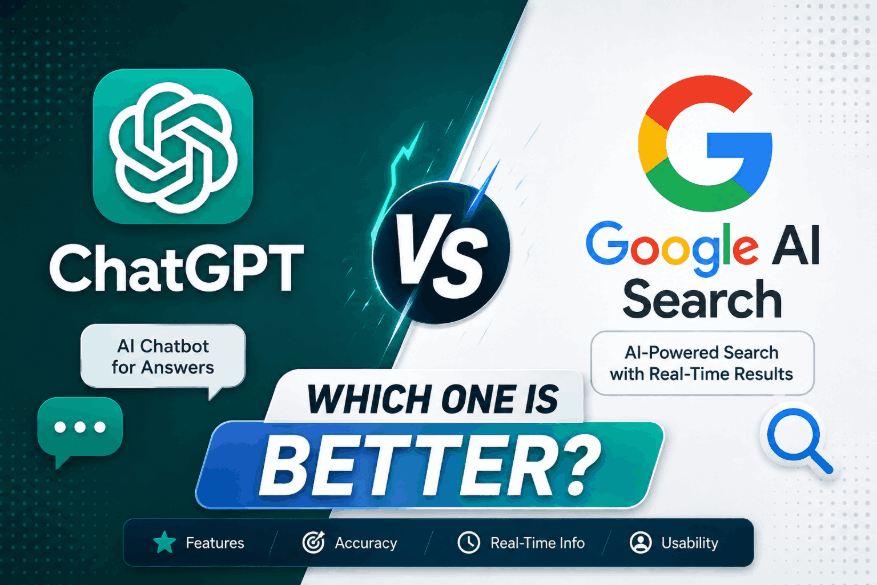
ChatGPT vs Google AI Search: Which One Is Better?
Artificial intelligence is changing the way people search for information online. For years, Google Search has been the first choice for finding websites, answers, products, news, tutorials, and almost everything else on the internet. Today, however, AI-powered tools such as ChatGPT are changing how users discover, understand, and interact with information.
This has created an interesting question: ChatGPT vs Google AI Search — which one is better?
The answer depends on what you are trying to accomplish. ChatGPT is particularly useful for conversations, explanations, brainstorming, writing, coding, and working through complex questions. Google AI Search, meanwhile, combines AI-generated answers with Google’s enormous search ecosystem, making it useful for discovering current information, websites, local businesses, products, news, and other web resources.
In this guide, we will compare ChatGPT and Google AI Search based on accuracy, current information, search experience, research, writing, shopping, local search, productivity, and everyday use.
What Is ChatGPT?
ChatGPT is an AI-powered conversational assistant developed by OpenAI. Instead of requiring users to search through a list of links, ChatGPT allows them to ask questions in natural language and continue the conversation with follow-up questions.
For example, instead of searching for:
“How does SEO work?”
you can ask ChatGPT:
“Explain SEO to me like I’m a beginner and give me a practical 30-day learning plan.”
The conversational format makes it possible to refine an answer without starting a completely new search.
ChatGPT can help with tasks such as:
- Writing and editing content
- Brainstorming ideas
- Explaining complicated subjects
- Summarizing information
- Creating outlines
- Programming and debugging
- Data analysis
- Research assistance
- Marketing ideas
- SEO planning
- Learning and education
- Generating creative concepts
Its biggest strength is not simply answering a question. It is helping users work through a problem interactively.
What Is Google AI Search?
Google AI Search refers to Google’s increasingly AI-powered search experience, including AI-generated summaries and other AI features integrated into Google Search.
Traditional Google Search primarily presents a ranked collection of webpages. AI-powered search can go a step further by synthesizing information from multiple sources and presenting a more direct response to a user’s query.
For example, someone searching:
“Best places to visit in Delhi for a weekend”
may receive a combination of AI-generated information, websites, maps, images, videos, reviews, and other search features.
Google’s major advantage is its connection to the broader web and Google’s search ecosystem.
Depending on the query, Google can help users discover:
- Websites
- News
- Maps and local businesses
- Images
- Videos
- Products
- Reviews
- Forums
- Official sources
- Recent information
This makes Google particularly powerful when the goal is discovering information and resources across the web.
ChatGPT vs Google AI Search: Key Difference
The biggest difference is the way the two platforms approach information.
ChatGPT is conversation-first.
Google AI Search is search-and-discovery-first.
ChatGPT is often better when you already know what you want to accomplish and need help thinking, explaining, creating, or solving.
Google is often better when you need to discover current webpages, businesses, products, news, sources, or other information available across the internet.
However, the line between these platforms is becoming increasingly blurred as both continue adding AI-powered features.
ChatGPT vs Google AI Search: Comparison
| Feature | ChatGPT | Google AI Search |
|---|---|---|
| Conversational questions | Excellent | Very Good |
| Writing assistance | Excellent | Good |
| Brainstorming | Excellent | Good |
| Coding assistance | Excellent | Good |
| Learning and explanations | Excellent | Very Good |
| Web discovery | Good | Excellent |
| Current news | Good with web access | Excellent |
| Local search | Good | Excellent |
| Maps and directions | Limited compared with Google ecosystem | Excellent |
| Shopping discovery | Good | Excellent |
| Creative work | Excellent | Good |
| Complex discussions | Excellent | Good |
| Finding websites | Good | Excellent |
| Source discovery | Good | Excellent |
| Productivity assistance | Excellent | Very Good |
The winner depends heavily on your specific use case.
1. Which Is Better for Everyday Questions?
For simple questions, both platforms can be useful.
Suppose you ask:
“What is blockchain?”
Google can provide webpages, explanations, videos, and other resources.
ChatGPT can explain blockchain in a conversational format and adjust the explanation based on your knowledge level.
For example, you could follow up with:
“Explain it using a simple real-world example.”
Then:
“Now explain it from a technical perspective.”
This makes ChatGPT particularly useful for interactive learning.
Winner: ChatGPT for conversational learning.
2. Which Is Better for Current Information?
When freshness matters, Google has a major advantage because search is designed around discovering information from the web.
Consider searches related to:
- Breaking news
- Current events
- Stock or market information
- New product releases
- Recent company announcements
- Local events
- Current prices
- Weather
- Sports results
Search engines are built to connect users with rapidly changing web information.
ChatGPT can also provide current information when web access and appropriate search capabilities are available, but users should still verify important facts against authoritative sources.
Winner: Google AI Search for broad real-time web discovery.
3. Which Is Better for Research?
This one is more complicated.
Google is excellent for source discovery.
If you are researching a topic, Google can help you find:
- Government websites
- Academic resources
- Company websites
- News publications
- Research papers
- Industry reports
- Expert articles
ChatGPT can be excellent for organizing and understanding information.
For example, you could use Google to discover several authoritative sources and then use ChatGPT to help:
- Compare the information
- Create an outline
- Explain difficult concepts
- Identify important themes
- Generate research questions
- Summarize provided material
4. Which Is Better for Content Writing?
ChatGPT has a major advantage for content creation.
It can help create:
- Blog outlines
- Blog introductions
- Headlines
- Meta descriptions
- Social media posts
- Email copy
- Product descriptions
- FAQs
- Content briefs
- Editing suggestions
For example, a content marketer could provide a target keyword and ask ChatGPT to develop a complete article structure.
Google Search is still extremely important for content writers because it helps them understand search intent and discover competing content.
A smart workflow is:
Google → Research → Analyze SERP → ChatGPT → Draft → Human editing → Fact-check → Publish
This combines Google’s discovery capabilities with ChatGPT’s writing assistance.
Winner: ChatGPT for writing; Google for research and search-intent analysis.
5. Which Is Better for SEO?
The answer is increasingly interesting for SEO professionals.
Traditional SEO focuses heavily on ranking webpages in search results.
AI-powered search is changing how users discover information.
SEO professionals now need to think about:
- Search intent
- Topical authority
- Helpful content
- First-hand experience
- Brand authority
- Structured content
- Entity optimization
- AI search visibility
- Generative Engine Optimization (GEO)
Google remains critical because it continues to be one of the world’s largest search ecosystems.
ChatGPT, meanwhile, represents the broader shift toward conversational discovery.
For SEO professionals, the best approach is not to choose one platform.
Instead, optimize content so that it is useful to:
- Search engines
- AI-powered search systems
- Human readers
Winner: Both, depending on the SEO objective.
6. Which Is Better for Learning?
ChatGPT is particularly strong for personalized learning.
Imagine you want to learn Python.
You can ask:
“Teach me Python from beginner to advanced.”
Then ask follow-up questions whenever you get stuck.
You can also request:
- Practice questions
- Coding exercises
- Explanations
- Examples
- Quizzes
- Study plans
- Project ideas
Google is useful for finding documentation, tutorials, courses, videos, forums, and official resources.
The best learning strategy may therefore be:
ChatGPT for explanation + Google for authoritative resources.
Winner: ChatGPT for interactive learning.
7. Which Is Better for Shopping?
Google has a strong advantage for product discovery.
When shopping online, users often need:
- Current prices
- Product availability
- Reviews
- Specifications
- Retailers
- Comparisons
- Images
- Local stores
Google’s search ecosystem can connect users with many of these resources.
ChatGPT can be useful for narrowing down choices and explaining differences between products.
For example:
“I need a laptop for video editing under my budget. What specifications should I look for?”
ChatGPT can help create a buying checklist.
Google can then help locate current products and prices.
Winner: Google AI Search for shopping discovery.
8. Which Is Better for Local Search?
Google has a significant advantage in local search.
If someone searches:
“Best restaurants near me”
Google can combine search results with maps, business profiles, reviews, opening hours, directions, photos, and other local information.
This makes Google extremely useful for local intent.
ChatGPT can help users decide what type of restaurant might suit them, but Google remains deeply integrated with local discovery.
Winner: Google AI Search.
9. Which Is Better for Coding?
ChatGPT is extremely useful for developers because it can provide conversational coding assistance.
Developers can use AI to:
- Explain code
- Find bugs
- Generate functions
- Convert code between languages
- Create examples
- Explain error messages
- Generate documentation
- Brainstorm solutions
Google remains valuable for finding:
- Official documentation
- GitHub repositories
- Stack Overflow discussions
- Framework documentation
- Technical articles
Therefore, developers can use both tools together.
Winner: ChatGPT for interactive coding assistance; Google for technical source discovery.
10. Which Is More Convenient?
Convenience depends on the task.
If you want a quick explanation, ChatGPT can be extremely convenient.
If you want to find a website, product, local business, current news story, or specific online resource, Google can be more convenient.
The important difference is:
ChatGPT helps you interact with information.
Google helps you navigate the information ecosystem.
Advantages of ChatGPT
ChatGPT offers several important advantages.
- Conversational Experience
- You can ask follow-up questions without repeating the entire context.
- Personalized Explanations
- You can ask for beginner, intermediate, or advanced explanations.
- Strong Writing Support
- It can help generate and improve many types of content.
- Brainstorming
- It can quickly generate ideas, angles, headlines, questions, and strategies.
- Coding Assistance
- It can explain programming concepts and help troubleshoot code.
- Productivity
- It can help organize ideas, create plans, summarize information, and assist with many everyday tasks.
- Advantages of Google AI Search
- Google also has several major strengths.
- Massive Web Index
- Google can help users discover an enormous amount of online information.
- Current Information
- Search is particularly useful when information changes frequently.
- Local Search
- Google’s maps and business ecosystem are extremely useful for local queries.
- Shopping
- Users can discover products, sellers, specifications, and reviews.
- News and Media
- Google can connect users with news websites, videos, images, and other media.
- Source Discovery
- Google makes it easy to find original webpages and official resources.
Limitations of ChatGPT
ChatGPT is powerful, but it is not perfect.
AI-generated answers can sometimes contain:
- Incorrect information
- Outdated information
- Missing context
- Overconfident statements
- Misinterpretations
For important subjects, users should verify information using reliable sources.
This is especially important for:
- Medical information
- Financial decisions
- Legal matters
- Current events
- Technical specifications
- Business-critical information
Limitations of Google AI Search
Google AI Search also has limitations.
AI-generated summaries may not always provide the complete context of the underlying sources.
Search results can also contain:
- Low-quality websites
- Outdated pages
- Advertisements
- Duplicate content
- SEO-focused content
- Conflicting information
Users should evaluate the credibility of sources instead of automatically trusting the first result.
Should You Use ChatGPT or Google AI Search?
The best answer is: use both.
Instead of treating them as direct competitors, think of them as different tools.
Use ChatGPT when you want to:
- Understand a complex topic
- Brainstorm ideas
- Write content
- Learn something
- Analyze information
- Solve a problem
- Generate code
- Create a plan
Use Google AI Search when you want to:
- Find websites
- Check current information
- Find local businesses
- Search for products
- Read recent news
- Discover original sources
- Find videos or images
- Compare online resources
ChatGPT vs Google AI Search for Bloggers
For bloggers, the combination can be especially powerful.
A practical workflow could look like this:
Step 1: Find a Topic
Use Google Trends and search results to identify topics people are interested in.
Step 2: Analyze Search Intent
Search the target keyword and study the types of results appearing.
Step 3: Research Competitors
Review the top-ranking pages and identify information gaps.
Step 4: Build an Outline
Use ChatGPT to organize the topic into a logical content structure.
Step 5: Write the First Draft
Use AI assistance to accelerate the writing process.
Step 6: Add Original Value
Include your own experience, examples, data, opinions, screenshots, and insights.
Step 7: Fact-Check
Verify important claims using reliable sources.
Step 8: Optimize for Search and Users
Improve headings, internal links, readability, keywords, FAQs, and structured information.
Step 9: Human Edit
AI should assist the writer, not replace editorial judgment.
The Future of Search
The future of search is unlikely to be controlled by only one platform.
Traditional search, AI assistants, AI-generated summaries, social media, video platforms, forums, and specialized search tools are increasingly becoming part of the information-discovery ecosystem.
Users may start with a conversational AI question, move to a search engine for verification, visit a website for detailed information, and then return to an AI assistant to summarize or analyze what they found.
This means businesses and publishers need to think beyond traditional rankings.
Creating accurate, useful, trustworthy, original, and genuinely helpful content will become increasingly important.
Final Verdict: ChatGPT vs Google AI Search — Which One Is Better?
So, ChatGPT vs Google AI Search: Which one is better?
There is no universal winner.
ChatGPT is better for conversation, learning, writing, brainstorming, coding, and problem-solving.
Google AI Search is better for web discovery, current information, local search, shopping, news, and finding original online resources.
For everyday users, the smartest strategy may be to use both.
Think of Google as a powerful gateway to the web and ChatGPT as an intelligent conversational assistant that helps you understand, create, and work with information.
The future of search isn’t necessarily about ChatGPT vs Google.
It is about knowing when to use each tool—and how to combine them effectively.
Frequently Asked Questions
1. Is ChatGPT better than Google Search?
Not for every task. ChatGPT is generally better for conversational assistance, explanations, writing, brainstorming, and problem-solving, while Google is often better for discovering current webpages, local information, products, news, and other online resources.
2. Can ChatGPT replace Google Search?
ChatGPT can replace traditional search for some types of questions, particularly when users want explanations or conversational assistance. However, Google remains highly useful for web discovery, local search, shopping, news, and finding original sources.
3. Which is better for SEO, ChatGPT or Google?
Google remains essential for traditional search visibility, while ChatGPT and other AI systems are contributing to a broader shift toward conversational and AI-assisted discovery. SEO professionals should focus on creating authoritative, useful content that can serve both humans and modern search experiences.
4. Is Google AI Search using artificial intelligence?
Yes. Google has increasingly integrated AI into its search experience to better understand queries and synthesize information, alongside traditional search features and web results.
5. Should bloggers use ChatGPT?
Bloggers can use ChatGPT as a writing and research assistant, but high-quality content should include human judgment, fact-checking, original insights, and useful information rather than simply publishing unedited AI-generated text.
6. What is the biggest difference between ChatGPT and Google AI Search?
The biggest difference is their primary user experience. ChatGPT is designed around conversational interaction and assistance, while Google AI Search is centered on search, information discovery, and access to the wider web.
Conclusion
The competition between AI assistants and search engines is transforming how people find and use information.
ChatGPT offers a powerful conversational experience that can help users think, learn, write, code, and solve problems. Google AI Search provides access to a massive web ecosystem and is particularly valuable for current information, discovery, local search, shopping, and finding sources.






One Comment